Clean Architecture: Structuring Software Around the Domain
Modern software systems often become difficult to maintain when business rules are mixed with frameworks, APIs, databases, and UI concerns. Clean Architecture addresses this problem by organizing the application into concentric layers, with the domain at the center and all dependencies directed inward.
At its core, Clean Architecture is a software design philosophy that places the domain model—the part of the system that encapsulates business logic, rules, and core concepts—at the heart of the solution. Around it sit the supporting layers that enable use cases, technical integration, and user interaction. The key governing principle is simple but powerful: all source code dependencies must point inward, from the outer layers toward the inner layers.
The Core Idea
The purpose of Clean Architecture is to protect the business core from external volatility. Technologies change, frameworks evolve, databases are replaced, and interfaces are redesigned. Business rules, however, should remain stable and independent. By isolating the domain from technical concerns, the architecture keeps the application easier to understand, test, evolve, and maintain over time.
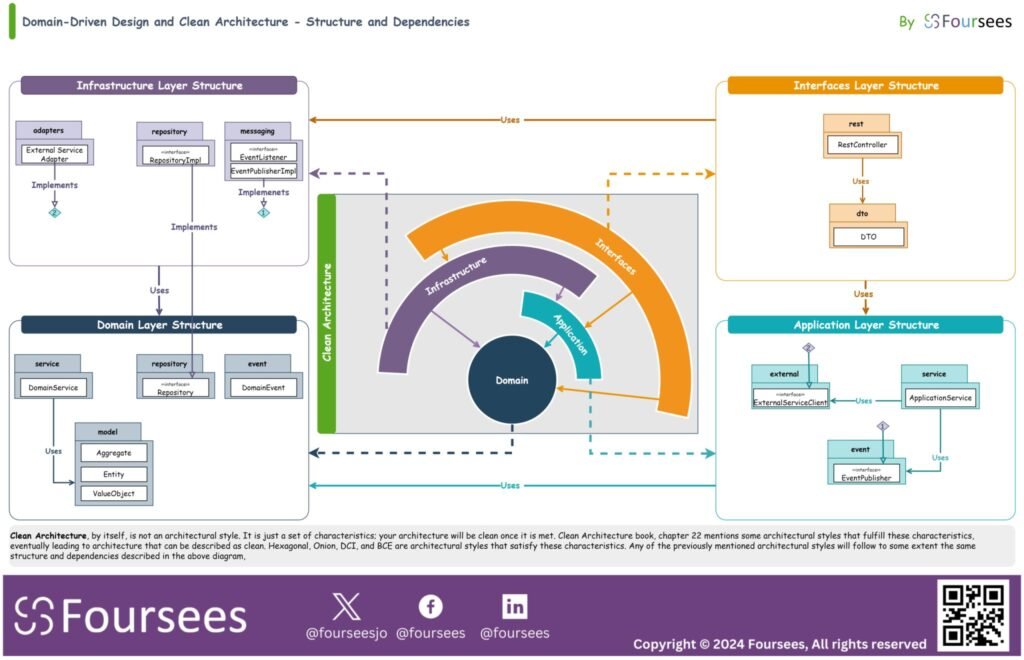
The diagram illustrates this clearly through four main layers:
1. Domain Layer
The Domain Layer is the center of the architecture and represents the business itself. It contains the most critical concepts and rules of the system, such as:
- entities
- value objects
- aggregates
- domain services
- domain events
- repository contracts
This layer must not depend on any outer layer. It should remain pure and focused only on business meaning and behavior. The domain defines what the system is and how it should behave from a business perspective.
Because it is the most stable part of the application, this layer should be insulated from implementation details such as REST, databases, messaging brokers, or external systems.
2. Application Layer
The Application Layer orchestrates the system’s use cases. It coordinates domain objects to support business operations without including infrastructure-specific concerns.
Typical responsibilities in this layer include:
- application services
- use case handlers
- input/output models
- ports for external services
- event publishing contracts
This layer depends on the domain and uses it to execute business workflows. It does not implement technical details directly; instead, it defines the interfaces and contracts needed by the outer layers.
In other words, the Application Layer answers the question: what should the system do to fulfill a business operation?
3. Interfaces Layer
The Interfaces Layer provides the entry points into the application. This is where the system interacts with users or external callers through mechanisms such as:
- REST controllers
- DTOs
- request/response mapping
- API endpoints
Its role is to translate external input into forms the Application Layer can understand and convert application output into transport-friendly structures.
This layer depends inward on the Application Layer, but it should not contain business logic. Its responsibility is interaction and translation, not decision-making.
4. Infrastructure Layer
The Infrastructure Layer contains the technical implementations required by the system, such as:
- repository implementations
- external service adapters
- event publishers and listeners
- database access
- messaging integration
- framework configuration
This layer is where abstract contracts defined in the inner layers are implemented. For example, the domain or application may define a repository interface, while the infrastructure layer provides the actual implementation using a specific database or ORM.
Infrastructure is necessary, but it should remain replaceable. Clean Architecture ensures that these technical choices do not drive the design of the business core.
Dependency Direction: The Defining Rule
The most important principle in Clean Architecture is the dependency rule:
dependencies always point inward.
This means:
- interfaces depend on the application
- infrastructure depends on application and domain contracts
- application depends on the domain
- domain depends on nothing external
The inner layers know nothing about the outer layers. The domain does not know whether it is being used through a web API, a message consumer, or a batch process. It does not know whether data is stored in SQL, NoSQL, or fetched from another platform. This separation is what gives the architecture its flexibility and resilience.
Why This Matters
When systems are not structured in this way, business logic often becomes scattered across controllers, service clients, repositories, and UI handlers. Over time, this leads to tight coupling, poor testability, and high change cost.
Clean Architecture provides several important benefits:
- Maintainability by separating business logic from technical implementation
- Testability because the domain and application layers can be tested independently of frameworks
- Flexibility to replace infrastructure or interface technologies with minimal impact
- Clarity through clear boundaries and responsibilities
- Longevity by preserving the business core from technology churn
Relationship with Domain-Driven Design
The diagram also reflects a strong alignment between Clean Architecture and Domain-Driven Design (DDD). DDD strengthens the inner core of the system by modeling the business explicitly through entities, value objects, aggregates, domain services, and domain events.
When combined, DDD provides the modeling discipline, while Clean Architecture provides the structural discipline. Together, they help teams build systems where the architecture supports the business model rather than distorting it.
Final Thought
Clean Architecture is not about drawing circles for their own sake. It is about ensuring that the business core remains at the center of the solution, protected from the instability of external technologies and delivery mechanisms.
By structuring software into concentric layers and enforcing inward dependency flow, teams can build systems that are more robust, adaptable, and aligned with business intent. The result is an architecture where the domain leads, and everything else supports it.
Ready to apply these insights?
Our architects are ready to help you design the path forward.
Book a Consultation